

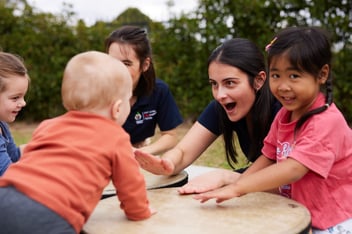

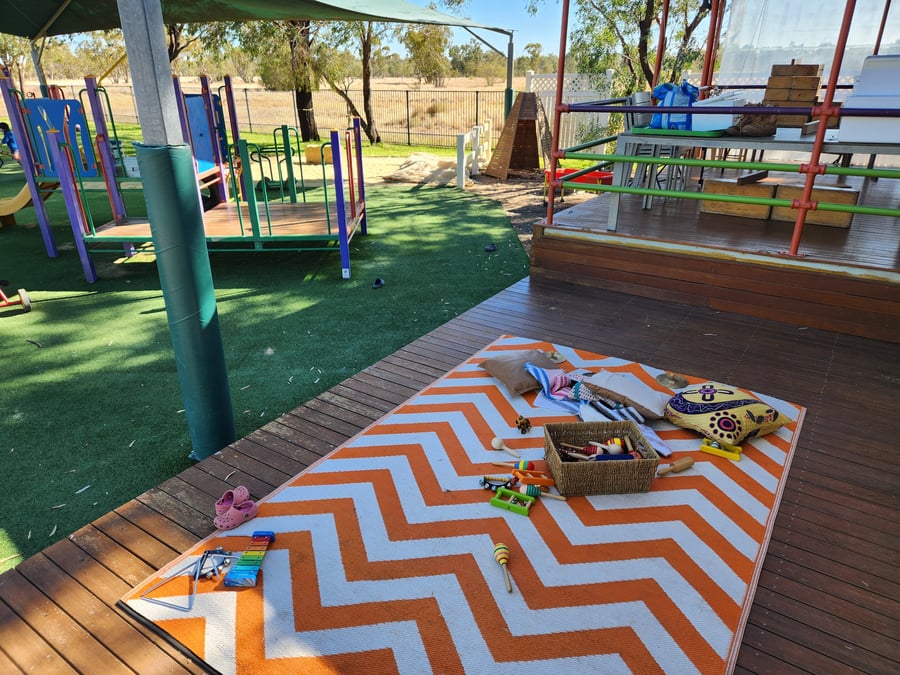
Music and nature come together in simple, joyful ways that support children’s wellbeing, especially in the first five years, when early experiences matter most. The natural world is full of opportunities for musical play, from listening to birds and wind, to tapping sticks, splashing in water, or crunching leaves underfoot. These everyday moments invite children to explore sound, movement and rhythm through play that is easy to access and doesn’t require special equipment.
When children combine music and nature in their play, they are building important skills across all areas of early development—thinking, moving, connecting with others, and expressing emotions. These playful experiences can also support children’s mental health, resilience and sense of calm. By simply stepping outside and following a child’s curiosity, families can create meaningful play moments where music and nature naturally work together to support learning and wellbeing.
Benefits of Outdoor Play for Children
As our Lunch and Learn presenters touched on during Nature Play month (view the video here) - when in nature, children often engage in games and engaging in this play can build a child’s decision-making, co-operation, negotiation, and conflict resolution skills. This can build social intelligence, empathy, and resilience. Independent or group play in nature can also help children overcome minor challenges and risks, which can promote a deeper understanding of their bodies, giving them a sense of control and agency. This can help to improve confidence and self-esteem. Nature play can also give children a deeper understanding of the world around them, as well as the important historical and cultural roots of their surroundings.
Nature and Music
If you step outside, close your eyes and listen, you’ll notice music all around you – from the rustling of leaves to the chirping of birds or the hum of the wind as it surrounds you. There is an intrinsic connection between music and nature, and when we tune in to what surrounds us, we can find rhythms, melodies and inspiration.
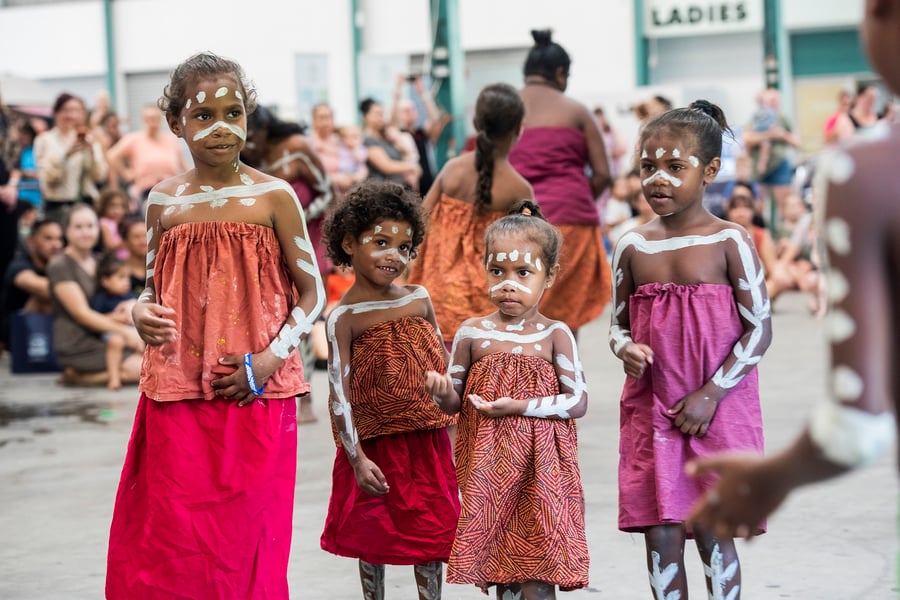
Nature has long inspired music across cultures, shaping everything from traditional songs to contemporary compositions. For Aboriginal and Torres Strait Islander peoples, music and nature are deeply connected through ongoing cultural practices.
In many Aboriginal cultures, songlines (also known as Dreaming tracks) are paths across the land, or even the sky, which record the journeys of ancestral beings during the Dreaming, the sacred time of creation.
These beings (spirits, animals, ancestors) shaped the world as they moved. As they walked, they sang the landscape into existence.
Each mountain, river, rock formation, waterhole, or tree wasn’t just placed there — it was sung there.
The songs tell the stories of how the land was formed, who it belongs to, and how to live in harmony with it. They encode everything: geography, spiritual law, hunting techniques, water sources, kinship rules, and cultural obligations. Walking On Country has more information on the importance of Songlines.
“Every place has a song. You just have to be still long enough to hear it.”
— Traditional saying from Yolngu Country
Integrating Nature Play and Music
Nature invites us to play, explore, and listen in new ways, transforming simple sounds into rhythms and melodies.
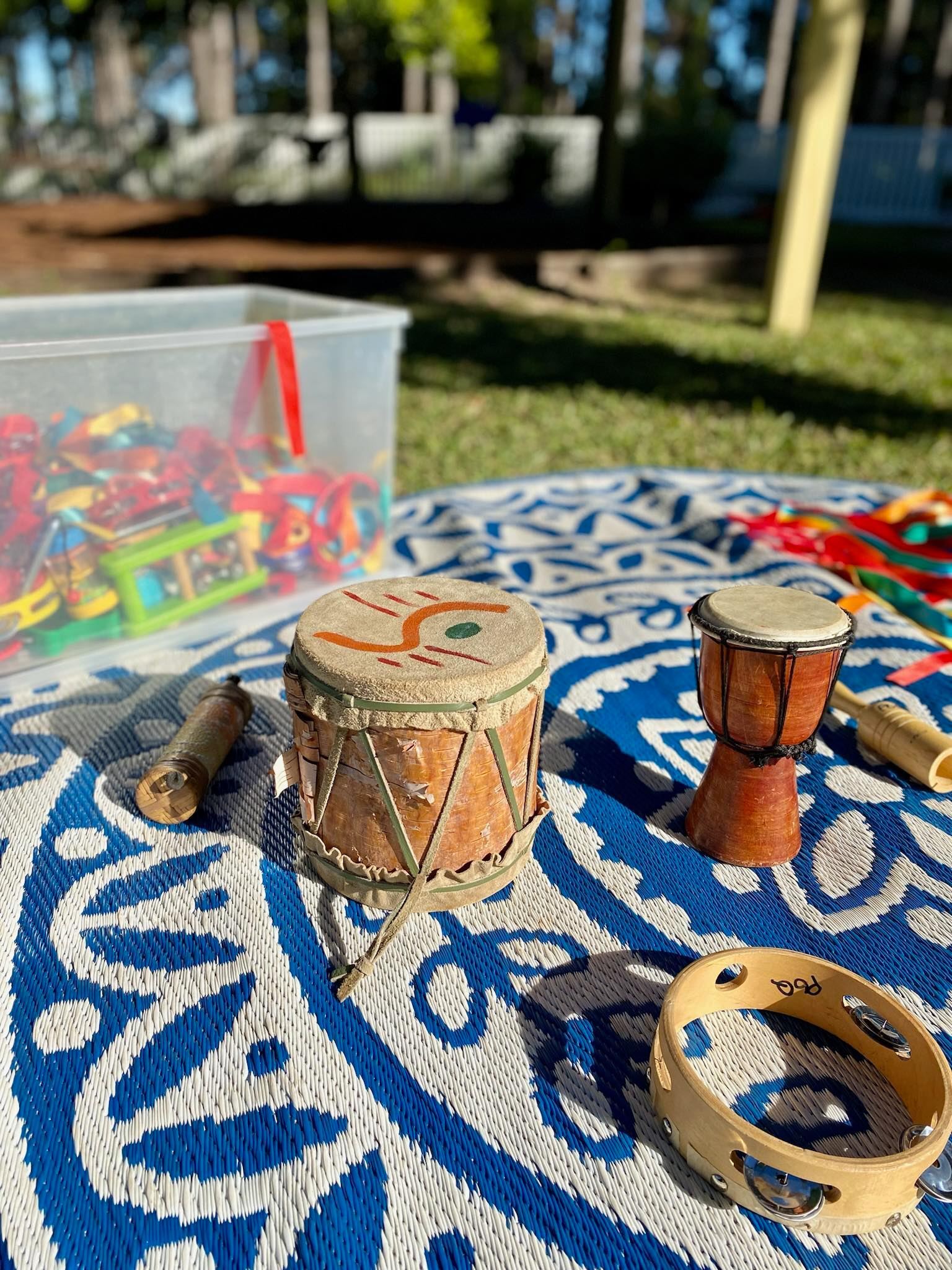
Beyond using nature as inspiration, we can also make music with nature itself. Many cultures around the world have used natural materials, such as stone, wood, or shells, to create instruments that reflect the sounds of the environment. But music and nature don’t just connect through instruments, there are endless ways to explore rhythm, melody, and movement outdoors. Whether it’s listening to the patterns in nature, using found objects to create sound, or singing in response to what we see and hear, engaging with music outside can be a playful and immersive experience. Here are a few simple ways to combine music and the natural world:
- Make your own instruments – Go on a nature hunt and find similar-sized sticks to use as claves (or rhythm sticks). Tap them together and see if different sizes create different sounds. You can also find small rocks, seed pods, cup them in your hands, and shake them like a maraca! Try this Nature Instruments Activity at home (login required).
- Singing with nature – Listen to birds chirping and try to mimic their calls with your voice. You can also turn your observations into song! For example: watch a line of ants marching by and sing “The Ants Go Marching”, changing the words to match what the ants are doing or where they are going.
- Listen to water – Head to your nearest body of water, whether it's the ocean with waves crashing or a creek with water streaming over rocks. Close your eyes and listen to the rhythm of the water. Try singing “Row, Row, Row Your Boat” and change the lyrics based on what you see. For example: "Row, row, row your boat, past the swimming fish!"
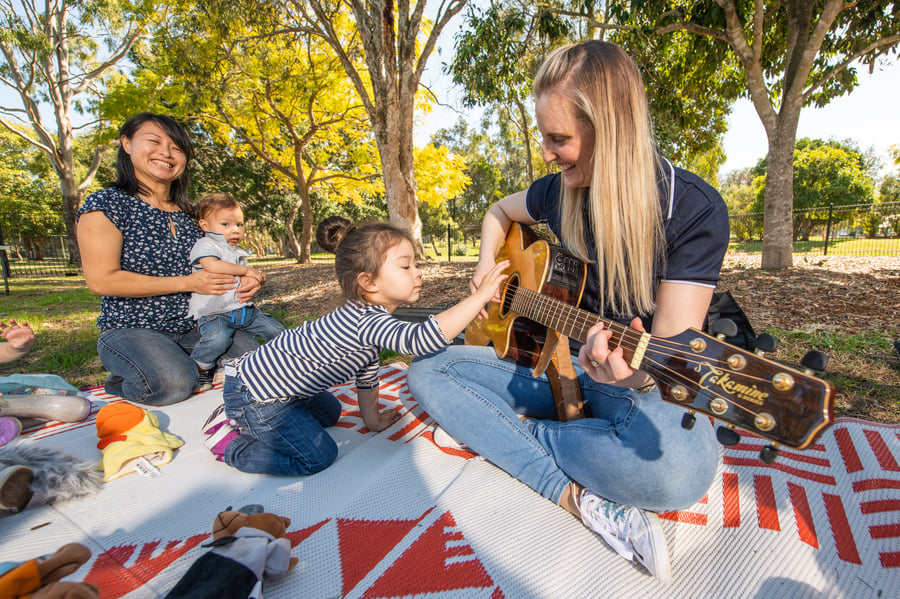
- Mimic nature sounds in music play – Use a big drum to mimic the crashes of thunder with your palms, and the pitter-patter of rain with your fingertips. Brush your hands over the surface as a windy day, and sing “I Hear Thunder”. Play bells while pretending to be birds, or shakers while pretending to be caught in the rain.
- Explore your local park while singing “We’re Going On A Bearhunt”. Take a teddy bear for an extra level of pretend play. Add the different elements of nature that you see to your lyrics, such as “Oh look! It’s a Grass Tree”
Music and nature have always been deeply connected, and by embracing this relationship, we can open new ways to experience sound, creativity, and play. The outdoors is the perfect setting for musical exploration as there are no rules, no right or wrong notes and just the joy of experimenting with sound. Whether it’s listening to the rhythms of water, mimicking bird songs, or making music with natural materials, nature invites us to play freely, using curiosity and imagination to turn everyday moments into musical adventures! Engaging with music in this way isn’t just fun, it can also enhance mindfulness, strengthen creativity, and encourage a deeper appreciation for the world around us.
For more ideas on creating instruments from nature, check out this video or jump onto the Play Matters free Membership portal and start making music with the world around you!
Play Matters Australia Sing&Grow program also has a great playlist of songs you can use as inspiration or ways to explore music, movement and nature as well.
If you haven't signed up to be a Play Matters member yet, it's free.
Resources
Alla, K., & Truong, M. (2024). Nature play and child wellbeing. Retrieved from https://aifs.gov.au/sites/default/2024-08/2408%20Nature%20play%20and%20child%20wellbeing.pdf
Clarke, N. (2024). Eight pieces of classical music inspired by the natural world. Retrieved from https://earth.fm/earth-stories/classical-music-inspired-by-the-natural-world/#:~:text=Sound%20and%20rhythm%2C%20two%20of,soundscapes%20have%20influenced%20musical%20composition
Huang, D. (2012). Connecting with Nature Through Music: Make & Play a Pow-Wow Drum. Retrieved from https://goexplorenature.com/2012/11/connecting-with-nature-through-music.html
MacDonald, J. B., Butler, K., & Alla, K. (2023). Engaging young children (0-5 years) in nature play. Retrieved from https://aifs.gov.au/sites/default/files/2023-11/2310_CFCA_PG_Engaging-young-children-in-nature-play.pdf
Nature Play QLD (n.d.). 10 Things To Do to Discover Nature’s Music. Retrieved from https://natureplayqld.org.au/wp-content/uploads/2020/07/10_Things_to_do_to_Discover_natures_music-1.pdf
Watarrka Foundation (n.d.). The Tradition of Aboriginal Music. Retrieved from https://www.watarrkafoundation.org.au/blog/the-tradition-of-aboriginal-music
Related content:
.jpg?width=352&name=YARRABAH%20(24).jpg)


Advertisement:
.jpg)
Discover the Play Hub!
Access over 100 activities, play resources,
videos and content.